✨ New Arrivals Just Dropped!Explore
HomeStore
New Horizons in Nanoelectrochemistry : Faraday Discussion 257 by Royal Society of Chemistry
New Horizons in Nanoelectrochemistry : Faraday Discussion 257 by Royal Society of Chemistry
The fundamental steps of electrochemistry occur at the nanoscale, and therefore through studying nanoelectrochemistry we can further our knowledge of electrochemical processes. Trying to expand our insight of these steps presents significant challenges, but new approaches and technologies mean our understanding has expanded greatly in recent years. This Faraday Discussion focuses on recent advances in nanoelectrochemistry, in which individual, transient intermediates and fast charge transfer at the nanointerface can be probed, enabling a comprehensive understanding of electrochemistry at any scale, from single entity to ensemble. This includes approaches combining nanoelectrochemistry with other techniques, new spectroscopic tools to investigate nanoelectrochemical processes, and new theoretical models being developed to understand the dynamic and stochastic processes during nanopore electrochemical confinement. This discussion focuses on the following four themes:Confined nanopore electrochemistryScanning electrochemical probe microscopySpectroelectrochemistry and light active processes at the NanointerfaceSystems Nanoelectrochemistry: From single-entity to ensemble
Binding: Hardback
Binding: Hardback
$80.25
Original: $229.28
-65%New Horizons in Nanoelectrochemistry : Faraday Discussion 257 by Royal Society of Chemistry—
$229.28
$80.25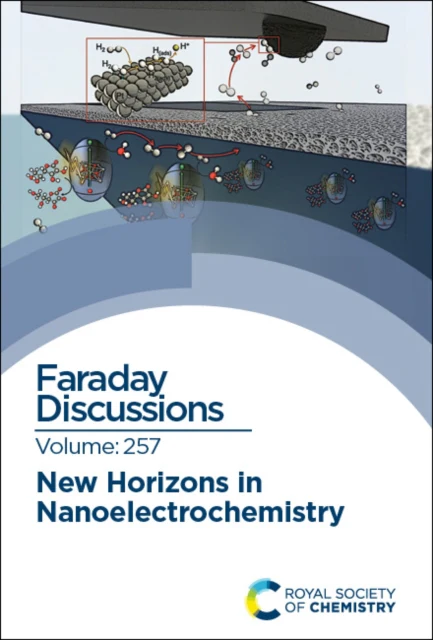
Description
The fundamental steps of electrochemistry occur at the nanoscale, and therefore through studying nanoelectrochemistry we can further our knowledge of electrochemical processes. Trying to expand our insight of these steps presents significant challenges, but new approaches and technologies mean our understanding has expanded greatly in recent years. This Faraday Discussion focuses on recent advances in nanoelectrochemistry, in which individual, transient intermediates and fast charge transfer at the nanointerface can be probed, enabling a comprehensive understanding of electrochemistry at any scale, from single entity to ensemble. This includes approaches combining nanoelectrochemistry with other techniques, new spectroscopic tools to investigate nanoelectrochemical processes, and new theoretical models being developed to understand the dynamic and stochastic processes during nanopore electrochemical confinement. This discussion focuses on the following four themes:Confined nanopore electrochemistryScanning electrochemical probe microscopySpectroelectrochemistry and light active processes at the NanointerfaceSystems Nanoelectrochemistry: From single-entity to ensemble
Binding: Hardback
Binding: Hardback